Consumer-Facing • B2C • 0-1 Design
Reducing Barriers to Women’s Participation in Pick-up Sports
HerGame was born out of a frustration I share with other women in recreational sports: wanting to play but not knowing where to go, or not feeling safe or welcome when they did. This mobile app helps women find, host, and join local pick-up games while building trust and community through play.
My Responsibilities
I led the full design process of this mobile app from research and flows to prototyping and user testing. The result was a high-fidelity prototype that addressed key usability concerns and validated strong demand for user-friendly systems that facilitate women-centered sports spaces.
A 36% increase in usability, resulting in 100% task completion.
Project Specs
Role: Solo UX & Product Designer
Project Type: Self-Initiated, Pre-MVP
Team: 2 product mentors, 2 consulting developers
Tools: Figma, Miro, Fig Jam
Timeline: Jun 2024 - now
Results at a Glance
Participants described the app as “easy to navigate” and “made for women like me.”
Further participant feedback confirmed a strong business opportunity and demand for a safe, consistent way for women to find and play games.
Problem
Women’s participation in sports is growing, but consistent access to casual play remains limited.
Team sports participation among girls aged 13–17 rose from 54% to 58% between 2020 and 2023, and over 226,000 women now compete in NCAA athletics, marking steady year-over-year growth. Yet many women still face barriers to showing up once they leave organized environments.
In HerGame’s user survey, 86% of adult women respondents reported difficulty finding and joining games consistently, and many described feeling uncomfortable or unsafe in co-ed spaces.
The issue isn’t whether women play — it’s why they don’t play more often. Gaps in structure, safety, and social support prevent women from turning interest into action, signaling both a social and business opportunity to make community sports more accessible and reliable.

Opportunity
How might we improve women’s access and play experiences in pick-up sports?
Goals
The goal of this project was to design a product experience that helps more women players find one another and participate in the games they already want to play.
HerGame focuses on reducing friction and uncertainty by making it easier to find trustworthy players, consistent schedules, and safe spaces. I didn’t only want to simplify the logistics of the game-finding process; I also wanted to foster a stronger sense of belonging and confidence around recreational play.
From a business standpoint, the design process explored how a women-centered sports platform could scale through community engagement and host-led models — validating both the user need and market potential for a safer, more reliable way to connect through sport.

Solution
DESIGN PRIORITY 1
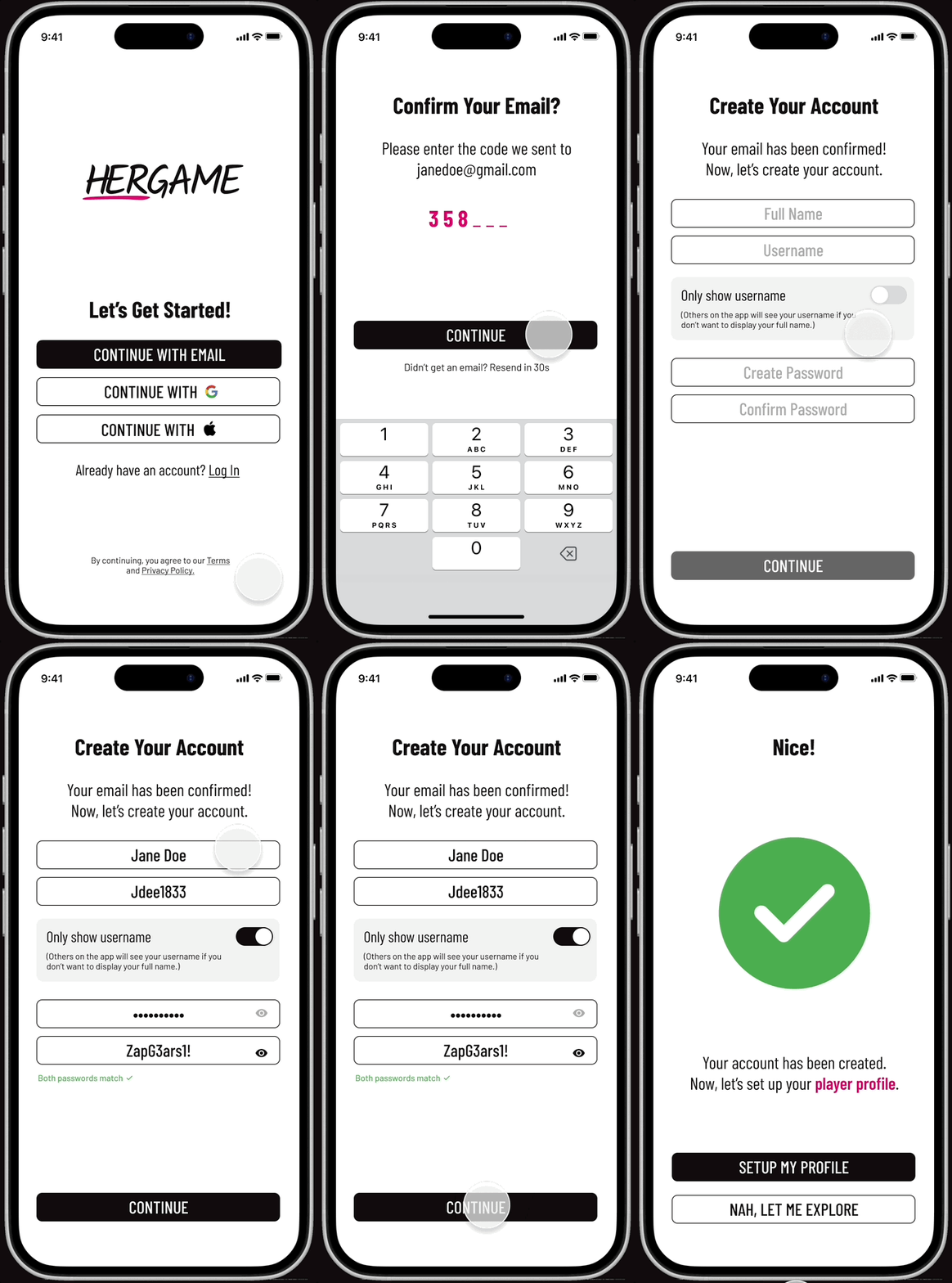
• Familiar and secure onboarding to help users create an account and get started quickly.
The HerGame mobile app introduces a simple and streamlined way for women to discover, host, and join local pick-up sports games with confidence.
The solution goes beyond logistics. HerGame creates both social permission and structural support for women to show up, participate, and build community through sport. It blends familiar UX patterns with thoughtful community features to make participation easy, safe, and consistent.
Key priorities included:
Creating a secure and friendly onboarding flow to help women get started quickly
Streamlined RSVP and host controls that reduce no-shows
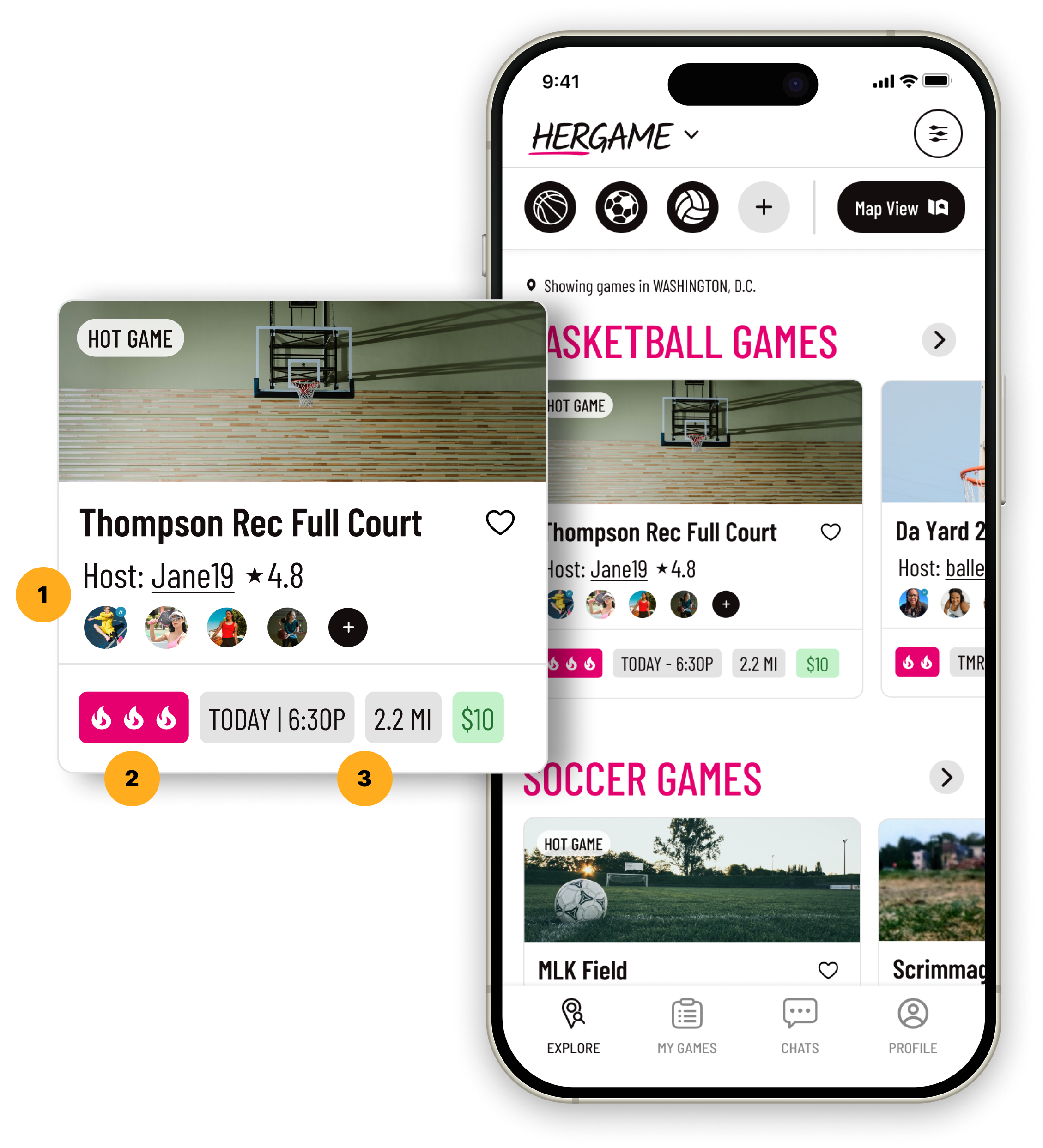
Game cards designed with clear social cues like who’s playing, skill level, competitiveness, and any fees
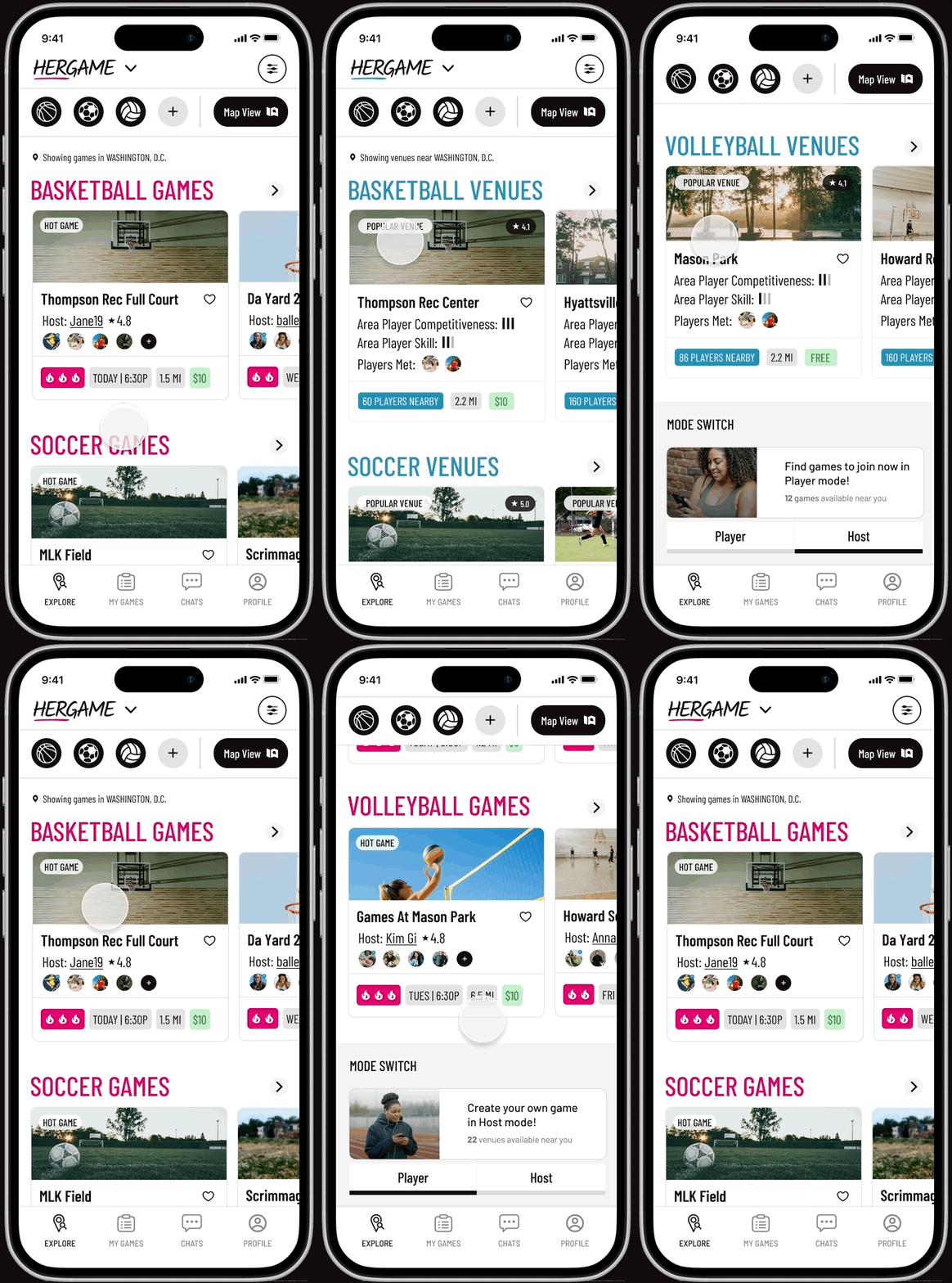
Quick switching between Player mode (to find games) and Host mode (to make games)
These elements work together to build trust, strengthen accountability, and make recreational play a regular, enjoyable part of women’s lives.
DESIGN PRIORITY 2
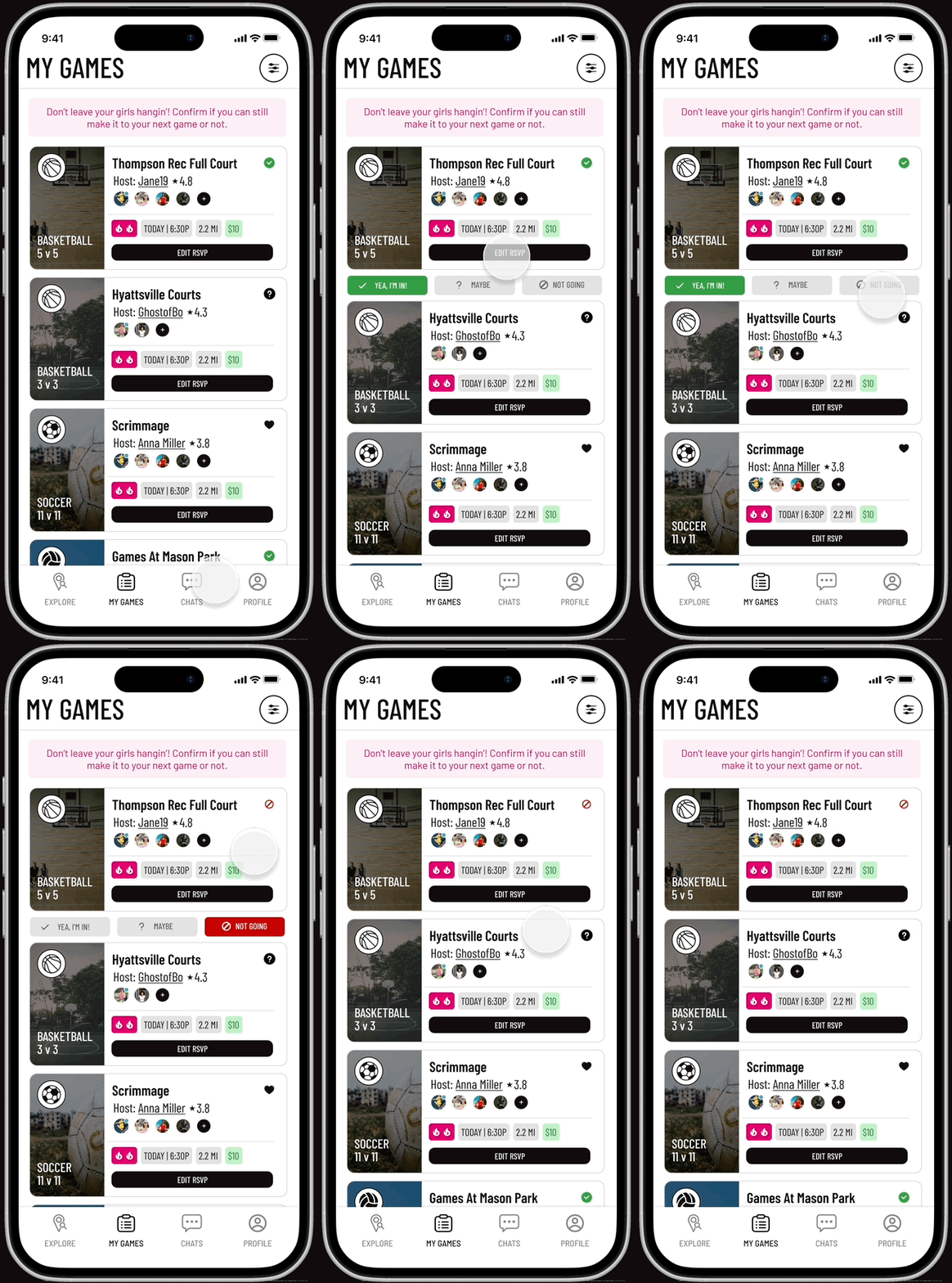
• Minimal RSVP and host controls to reduce no-shows and increase accountability.
DESIGN PRIORITY 3
• Game cards with clear social cues and info tags like:
1. Who’s playing
2. Intensity of competitiveness
3. Day, time, distance, and any game fees
DESIGN PRIORITY 4
• Quick and easy switching between Player Mode and Host Mode

Research & Design
Understanding the Problem
I began by listening first to understand why women don’t play as often as they may want to.
I surveyed and interviewed a range of women, from former college athletes to beginners. I knew what kind of challenges and frustrations I was facing as a recreational female athlete, but it was important for me to hear the real-world frustrations of others. The goal was to understand both logistical and emotional blockers — what was keeping women from playing, even when they want to?
Key insights from secondary & primary user research:
86% of respondents found it difficult to find and join games consistently.
Many women felt anxiety or discomfort in co-ed or male-dominated environments.
Users craved a platform that was casual, easy to navigate, and built for them.
Unclear skill levels, no-show players, and scheduling gaps reduced reliability.
These findings informed everything from core features to the app’s tone of voice.
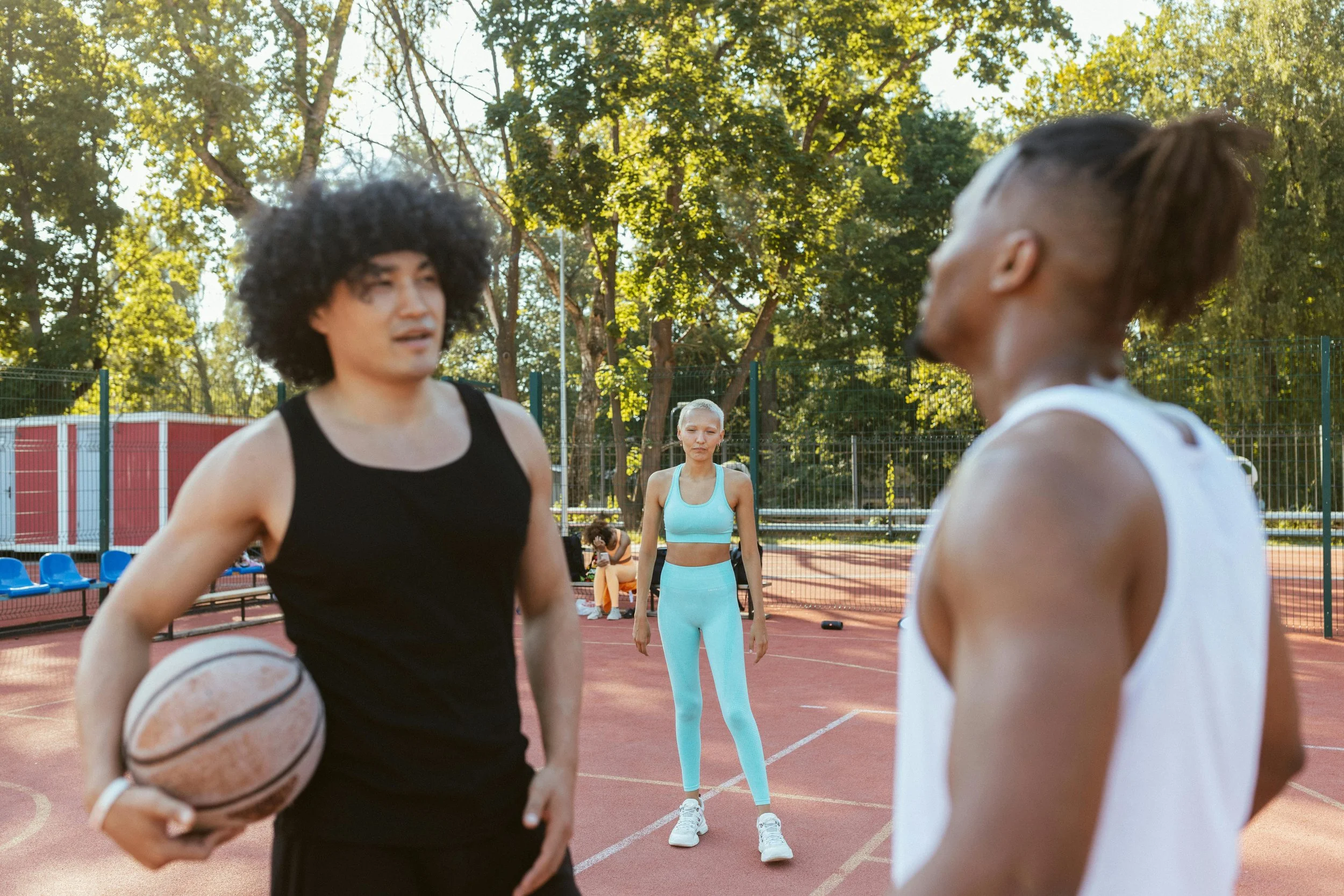
“In co-ed games, if you’re not as skilled, it’s because you’re ‘just a girl’, but if you’re good or better, then the tone sometimes shifts to something more aggressive and unfriendly. The unpredictability is exhausting.”
- Acrivi C., Interviewee & Tester
Design
Designing HerGame meant finding a balance between emotional and functional needs.
Designing for Belonging
Rather than leading with features, I grounded each decision in three key intentions:
1. Connection – Build familiarity before players meet in person
2. Commitment – Make it easier to show up without pressure
3. Comfort – Reduce intimidation and signal safety and inclusion
This meant creating flows that encouraged trust without demanding too much from new users. Every screen — from onboarding to RSVP management — was designed to feel clear, calm, and supportive.
1. Building for connection meant carefully synthesising survey response data to narrow in on the user needs that stood out the most.
2. Getting players to commit to games meant thinking of ways to make it easy to find and assess gameplay
3. Comfort through design meant considering language, tone, and user privacy throughout the system.
Portions of user onboarding flow

Designing for Simplicity & Confidence
HerGame had to feel intuitive, even for users unfamiliar with fitness apps. I prioritized:
1. Streamlined flows for quick actions like joining, hosting, or updating RSVP
2. Gentle nudges to reduce no-shows without shame
3. A visual style that felt modern, energetic, and welcoming
This meant creating flows that encouraged trust without demanding too much from new users. Every screen — from onboarding to RSVP management — was designed to feel clear, calm, and supportive.
1. Streamlined flows meant simple actions for quick updates and notifications between players and hosts
2. Gentle nudges meant small reminders on the benefits of being communicative and reliable, and making it easy to change your status


3. Visual style that felt modern, familiar, and welcoming meant considering color, contrast, and use of white space in ways that were proven to work through testing—not just a pretty vibe.
Visual design evolution of RSVP flow
Results & Learning
Results
User Feedback & Usability Testing
Two rounds of usability testing — held remotely and on-site — revealed strong enthusiasm for the concept and positive reactions to the experience.
“I wish something like this had existed when I was younger.”
- Ash, Tester, Former D1 Athlete
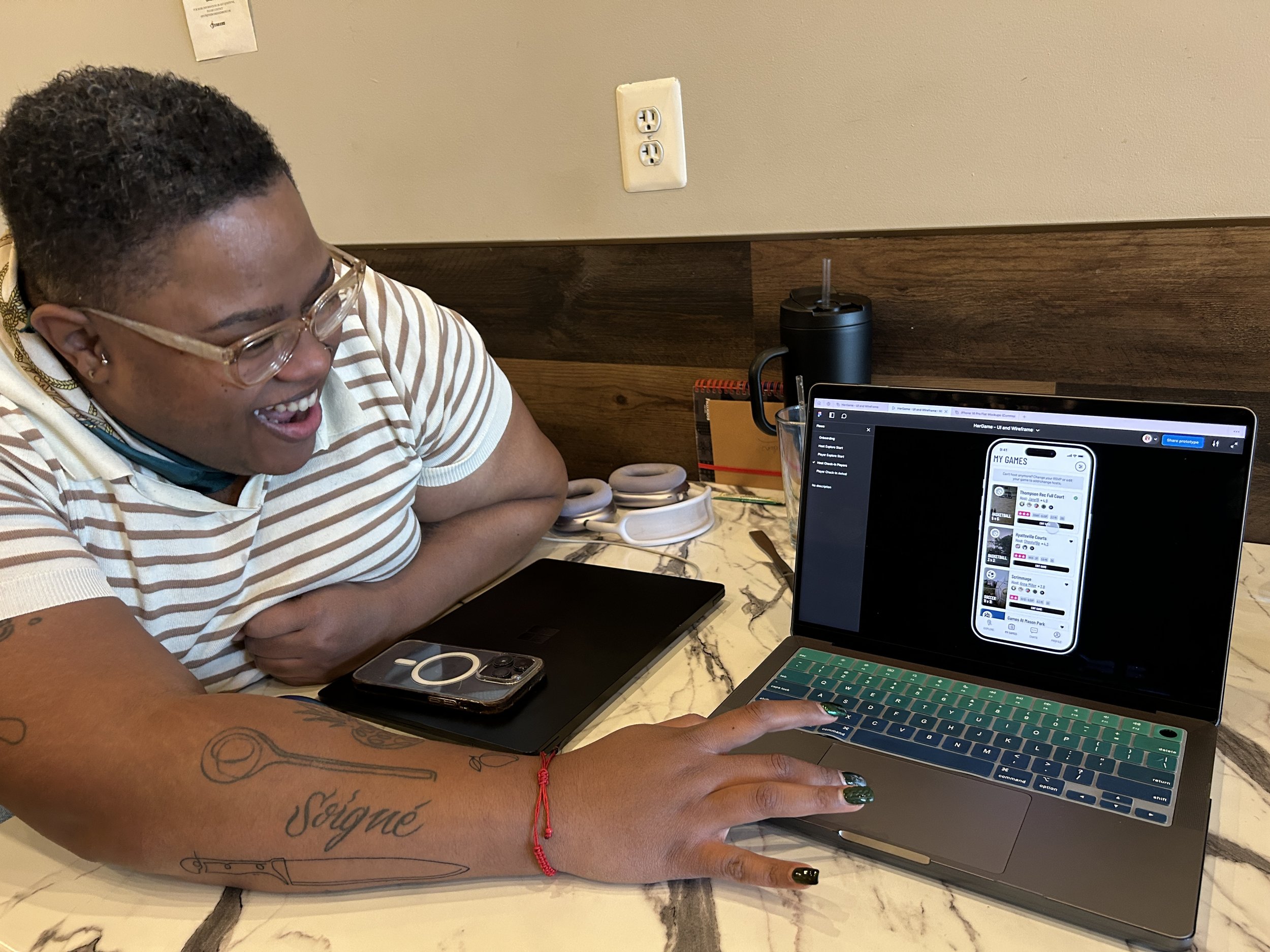
Testing session held at a cafe with Dani H.
What users showed me:
The app felt inviting, modern, and easy to trust
Casual players felt comfortable using it and could see themselves playing more often
Several said they felt like they were finally the intended user of a sports app
86% navigated key flows (onboarding, RSVP, host controls) without guidance
Usability testing also surfaced specific improvements, which led to:
More intuitive RSVP controls
Clearer game visibility and player details
Improved onboarding tips to build confidence from the start
What I Learned
Designing HerGame reinforced several important principles that I’ll carry forward into future work:
Design for someone, not everyone.
Staying focused on a clear primary user helped me make better, more intentional design decisions.
Validate early and often.
Assumptions I had about flow clarity and user priorities were challenged through testing — and the product got stronger every time I listened.
Small touches matter.
Microcopy, tone, spacing, and visual contrast all contributed to how confident and comfortable users felt navigating the app.
Next Steps
Building out messaging and invite flows to strengthen community connection
Refining the venue participation strategy for local partnerships and game hosting
MVP development and closed beta testing
The long-term vision is to support a wide range of play styles — whether someone wants to shoot around with a few friends or organize a full scrimmage. At its core, HerGame is about making it easier for more women to play, more often.